About Me

My photo
Pilgrim, priest and ponderer. European living in North East England. Retired parish priest, theological educator, cathedral precentor and dean.
Showing posts with label pilgrimage. Show all posts

Monday, 9 March 2020

A Path by Land and Sea: the Way of St Hild

 This is a remarkable gathering in a remarkable place on a remarkable day. And all because of a remarkable woman. It’s St Hild we have to thank for inspiring this celebration that begins here at Hartlepool and ends at Whitby this afternoon. Two places that cherish the memory of this great Saxon woman, and now a pilgrim path along the North Sea coast to link them, the Way of St Hild.  

You might think it’s a little eccentric to look back across more than thirteen hundred years to find inspiration for this project. But the North is fiercely proud of its saints: Aidan, Oswald, Benedict Biscop, Wilfred, Chad, Cuthbert, and Bede whose writing lovingly tell their stories and help us imagine the world they lived in. Hild was one of these men and women of Northumbria’s Golden Age who shaped the culture and spirituality of the North East, to whom we owe so much of the North East’s identity and character and its marvellous ‘sense of place’. To Northerners, these legendary saints aren’t locked into some remote and distant past. They are our contemporaries, our fellow-travellers, our friends. 

St Hild would have known intimately the route that bears her name. As Abbess first of Hartlepool and then of Whitby, she must often have made the journey between them, whether walking or riding the marshlands and the high cliffs, or viewing them from afar as she plied the highway of the great grey ocean. What’s more, her family links to the Northumbrian royal house at Bamburgh and to the mother house on Lindisfarne would have taken her to the northern reaches of the kingdom too, past South Shields where there is another church dedicated to her and where she may have founded her first convent. 

‘All who knew Hild the handmaiden of Christ called her mother because of her outstanding devotion and grace’ says Bede. He writes about her as ‘a jewel in the land’, a shining light as a Christian leader, teacher, reconciler and healer. Her name means battle and she did indeed live through turbulent times. A Synod at Whitby in 664 at which King Oswiu presided called for leadership skills of the highest order when church and state were bitterly divided. She died full of years in 680. On her deathbed she urged her brothers and sisters ‘to preserve the gospel peace among themselves and towards others’, to live out the virtues of service to others as she herself had done throughout her life. 

Our new Way of St Hild sets out to tell her story and celebrate her legacy. It does this not only by referring back to the events of her life, but by setting her in the context of her times, of the natural landscapes her path traverses, and of the events that subsequently changed the world she knew, sometimes, we can safely say, beyond anything she could have imagined in her lifetime. The natural environment of salt marsh and estuary and cliff top, the profusion of birdlife and wildlife, the fossil memories from aeons past she would recognise today. The sound of the salt sea crashing against the old eternal rocks would always have been music to her ears, for it was this that she taught Caedmon the cowherd to sing about as he found his voice to praise the Creator. 

But what would she have made of the heavy industry of Teesmouth, the comings and goings of rigs and tankers, the steel, iron and alum works on the edge of the moors, feats of heavy 
engineering like the Middlesbrough Transporter Bridge, or facilities along the coast dedicated to tourism, sport and leisure? One of the fascinations of creating this route has been the extraordinary contrasts you encounter on the Way of St Hild. And inviting reflection on what it could all mean to men and women of our twenty-first century. So this pilgrim path is as much a celebration of human activity and achievement – with all its dilemmas and compromises - as it is of the beauties of the natural world and the life and times of one of our greatest saints. 

It’s a remarkable collaboration between Hartlepool Council and neighbouring local authorities, the churches, tourism agencies, the Royal Navy, and people and organisations that care for and interpret our natural and built heritage. Hild would have liked that spirit of common purpose. And given her adventurous spirit, she’d have liked, I think, the digital access to the pilgrimage that’s been created through augmented reality stations, so that people with limited or no mobility can still be pilgrims and walk the route on their smartphone. 

It’s appropriate to be doing this in 2020 as our contribution to this ‘Year of Pilgrimage’ that’s being observed by cathedrals and pilgrimage sites across the land. Durham Cathedral is the focal point of a cluster of new pilgrim routes being launched this year, one of which connects with the Way of St Hild here on the Headland at Hartlepool. The capacity of saints and holy places to inspire pilgrimage is evidence of the interest being awakened today in what’s being called ‘religious tourism’. Stories like Hild’s are Christian in origin. Yet like the pilgrim routes to Compostela, Jerusalem and Canterbury, interest in pilgrimage is alive in people of many faiths and of no faith in particular for whom the spiritual search is a fundamental aspect of being alive. I don’t hesitate to claim that Hild’s faith prized inclusion as a basic Christian value. That’s the spirit in which we have tried to create this pilgrimage.

Which brings me to my final point. The more I study Bede’s writings about St Hild and her legacy as a Christian leader, the more remarkable I find it that a woman should have been entrusted with the authority conferred on her as a medieval abbess by bishops and kings. Saxon monasteries were not primarily places of retreat but centres from which the land was Christianised and ruled, and affairs of state were managed. Politics and religion were inextricably intertwined in places like Hartlepool and Whitby. The woman whose memory is enshrined in our pilgrim path belonged to the front rank of leaders in the Saxon world. No wonder Bishop Aidan ‘loved her heartily for her innate wisdom and her devotion to the service of God’.

So you’ll not be surprised that there was a fond wish to launch The Way of St Hild on International Women’s Day 2020, Sunday 8 March. This year’s theme is Generation Equality, meaning the empowerment of women and girls not only for good citizenship but also for leadership in the worlds of today and tomorrow. Like Ruth in our first reading, Hild speaks to us across the centuries of all that represents the best and noblest in human character, giftedness and service. She is a woman for us all to be proud of, and whether as women or men, to emulate as we ask ourselves what it might mean to serve God and our neighbour in whatever capacity he calls us to at just such a time as this? 
St Hilda, Hartlepool
Sunday 8 March 2020

Monday, 1 July 2019

The Way of St Hild: a new pilgrim route

When we think about The Way of Saint Hild our first thoughts are naturally about Hild herself, the life and times of this great Saxon woman, and how the themes of her life might speak to us today. And I shall come on to her shortly. But before we do, I want to look briefly at the other important word in this project title, Way. 

The idea of pilgrimage trails is ancient. For centuries people have criss-crossed Europe to undertake pilgrimages to the great Christian shrines of Jerusalem, Rome and Santiago da Compostela where I was two months ago. Here in England among prominent pilgrim destinations have been, and still are, Canterbury, Walsingham and Glastonbury. And in the North East, Lindisfarne, Hexham, Jarrow, Wearmouth and Durham where I was privileged to spend thirteen years of my life as, you might say, a guardian of St Cuthbert’s shrine.

Among those honoured places here in the North East are, or ought to be, South Shields, Whitby and Hartlepool, the three sites most closely associated with St Hild, and through her, the Saxon saints of the seventh century. The Way of St Hild will link the two southern sites associated with her, a pilgrim path along the North Sea that connects St Hilda’s Church on Hartlepool’s Headland to the Abbey on the cliffs above Whitby. 


What is a pilgrimage for? Why would anyone want to walk the path we are creating? Why do people already walk the St Cuthbert’s Way from Melrose to Holy Island, and the St Oswald’s Way from Holy Island to Heavenfield? This seems to me to be a fundamental question to ask if we are going to make sense of this project. 

A pilgrimage is a journey with a purpose. Traditionally, that meant a religious purpose, making an often long and arduous journey to visit a place associated with some key event in the story of faith, or with the lives of holy men and women who are revered in that story. The tradition speaks about holy places, sites that have been touched and lit up in some way because of those associations. “Hild was here.” And insofar as the whole journey is inspired by this sense of holy purpose, we can say that it comes to define a sacred geography, a landscape imbued with historical, cultural and spiritual meanings
So pilgrimage declares: this is not just any landscape, however historic, however beautiful. The pilgrim way contributes to what we can call place-making. Its very existence enhances our understanding of our native geography, its genius loci or “spirit of the place” that makes it what it is, or as we tend to say nowadays, its sense of place. The journey may already be familiar or be travelled for the first time. The important thing is that pilgrimage lends it added significance. It suggests new ways of looking at it because of the stories it commemorates. There are new interpretations, new meanings, new textures. 
Historically, pilgrimage has been defined in terms of journeys with a religious purpose, but I need to broaden that understanding. A journey can have many kinds of purpose that are not always overtly religious. Veterans travel to honour war graves where their comrades lie buried. Holidaymakers visit distant places they haven’t been to before to learn about their culture and art, meet their peoples and admire their landscapes. People go back to their birthplace or where their ancestors have lived. These are all pilgrimages in their different ways. A holiday is literally a holy day. That makes the point. 
The Way of St Hild is offered as a journey that carries multiple significance. We can see this clearly from the twelve proposed stations for the “augmented reality” interpretations. It begins and ends with churches associated with St Hild herself, a traditional way of setting out and completing a pilgrimage at a sacred site. Some set our saint in the context of the Saxon era and explore how her story was told and her pilgrimage developed into the later middle ages and beyond. Another identifies her as one of a North East cluster of holy men and women who were honoured by pilgrimages. But some stations are more historical. They make us aware of the Anglo-Saxon culture in which Hild lived and that the pilgrimage landscape has a prehistory going back to Roman times. One of them opens up an aspect of the natural world, the wildlife of the Tees Estuary and helps us understand the landscapes that Hild knew and that formed her as a northern saint. Not all of these are directly focused on Hild herself, but all of them contribute to the rich texture of this pilgrim journey and place her story in a larger context than simply her own life and times.
One of the important aspects of any pilgrimage is that while it often commemorates people or events in the past, at its best it is never backward-looking. That is to say, good pilgrimage makes a distinction between the past in itself, the past as it’s featured in the stories told about it by subsequent generations, and the past as we ourselves encounter and experience it as people of today. Theologians talk about anamnesis, bringing the past into the present so that it has the potential to shed light upon our contemporary concerns and even contribute to shaping the future. This is what is happening when Christians celebrate the eucharist and take bread and wine “in remembrance of me”, not to relive the past memory but to actualise it in the present, make it a real agency of transformation. 
This seems to me to be crucial in the way we set about the project of imagining this particular Hild-inspired journey and creating it as an offer to enrich people’s lives. How do we avoid setting up an exercise that is no more than an exercise in recreating the past? By taking an intentionally holistic view of what we are engaged in, not least in its connections with our contemporary world. This means broadening the scope as far as we can while preserving the integrity of the controlling theme of St Hild. I shall come back to this later on.
I began by defining pilgrimage as journey with a purpose. Ultimately, I guess that purpose means our own self-understanding as contemporary men and women. A way is more than a physical path. It suggests our way of life, a spirituality of being human, the journey we cannot help making if we are serious about human life and being good citizens of our age. We want in our best moments to know our place in the world and how we can leave a legacy that will have added value and enhanced not only our own lives but those of our successors.

********
So much for the meanings of pilgrimage. I want now to turn to Hild herself and how we should commemorate her in this pilgrim journey. Let me say something about her life and times, and then suggest themes to consider as we create this pilgrimage that bears her name. 
Our source for the life of St Hild (in Latin, Hilda) is the Venerable Bede, that great chronicler of the late seventh and early eighth century to whom we owe the very idea of “England”. As a Northumbrian living in the double monastery of Wearmouth and Jarrow, his focus was inevitably northern which makes him the best (and often only) authority on Christian Northumbria in what we’ve come to call its golden age. It is agreed by all that Bede was a scrupulous historian when judged by the criteria of his times, and a wealth of information about the Saxon kingdom and its people has been preserved to us which would otherwise have been lost.
He tells us that Hild was a Saxon princess who was brought up in the court of King Edwin of Northumbria. When he converted to Christianity in 627, the first Northumbrian king to do so, he and his entire court were baptised by Paulinus at York, including the thirteen-year old Hild. Sent away to the safety of the south when Edwin was killed by the Mercians in 633, she returned to Northumbria at the summons of Aidan of Lindisfarne who asked her to found a religious community somewhere north of the River Wear. Tradition identifies this with the ancient Christian site on which St Hilda’s Church in South Shields was later built. In 649 Aidan appointed her as Abbess of the double monastery at Hartlepool, a community of men and women who took vows and lived separately but worshipped together in their abbey church. In keeping with Northumbrian Christian tradition instituted by Bishop Aidan, himself an Irishman, their rule of life would have drawn on Irish rather than Roman Benedictine monasticism.
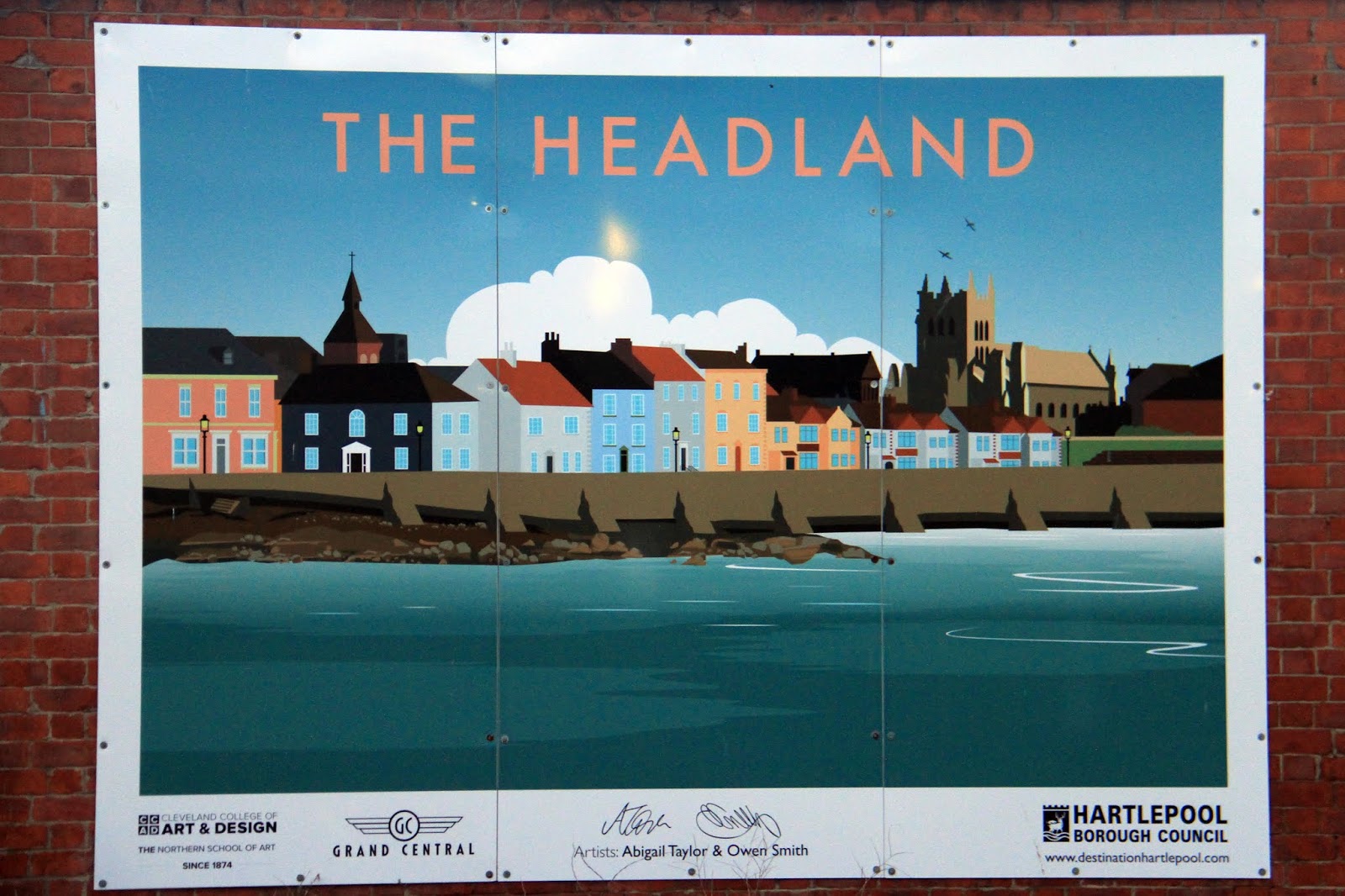
Again, we don’t know precisely where the community was situated but we can assume it to have been on the Headland by St Hilda’s Church where the remains of the medieval sea wall and the convent cemetery can still be seen. Perhaps we should see the Headland as a second Lindisfarne, an almost-island that was conducive to spiritual reflection and the life of prayer. The Saxon church loved these semi-detached places by the sea, isolated in themselves yet always connected to the mainland. Even today, the Headland retains these qualities despite – or perhaps because – of its urban character. It’s one of the most magical places I know. In my book Landscapes of Faith I said of it that “it is quintessentially north eastern in its marriage of a centuries-old Christian history and more modern urbanisation”. Like Bede’s churches at Wearmouth and Jarrow, the Saxon churches at Billingham and Escomb, and Durham Cathedral itself. 
Hild founded Whitby Abbey in 657. This too was a double monastery, and there is no reason to doubt that it was situated on the cliffs near the Benedictine abbey that was built there in the thirteenth century. (Indeed, it could even be possible that it was “double” in the sense Wearmouth-Jarrow was: a single convent on two geographical sites, Hartlepool and Whitby.) Bede commends Whitby as a model of its kind, a house of discipline, prayer, learning, good works, peaceability and charity. Its greatest moment took place in the year 664. Oswiu, Oswald’s brother and successor as King of Northumbria, convened a synod there to resolve matters of dispute in the church of which he was the leading lay person. 
The principal point of contention concerned the date of Easter. This may seem arcane to us today, but to Christians in the early centuries of the church’s history it was a matter of extreme importance to celebrate the festival of the resurrection on the correct day and together. Bede himself wrote about the mathematics and astronomy that underlay the complex calculations. Irish tradition, inherited by the influential community on Lindisfarne, calculated the date one way, Catholics, taking their lead from the continental European church and St Augustine’s mission in the southern kingdoms, in another. This was a sharply personal issue for Oswiu because while he like his brother followed the Irish calendar, his queen Eanfleda who had been brought up in Kent followed Roman practice. This meant that one of them could be feasting in Eastertide while the other was still fasting rigorously in Lent. What was at stake was the unity of the Northumbrian church. But more than that, the kingdom’s political relationships with the rest of England and with the continent had everything to gain by reaching agreement.
Oswiu listened carefully, then decided in favour of the Catholic way and imposed it on his kingdom. This was how decisions were made in those days. Cuius regio, eius religio – you followed the religion of whoever reigned over you. Those on Lindisfarne who could not accept it returned to Iona where they had come from, and then to the north of Ireland (where, in due course, the church fell into line with the Catholic south, thus ending a schism that had divided the western church). For Bede, the Synod of Whitby was a turning point in the history of the northern church. And we can see Hild’s role in the synod as presiding over bitterly contested ground, acknowledging the outcome of the dispute, and promoting its acceptance among the company of those gathered in her monastery and in the wider Northumbrian church – all the more impressive for the fact that she personally inclined to the Irish tradition in which she had been formed, rather than the Roman.
Hild died on 17 November 680. It was not long before her memory began to be venerated. We know this from a church calendar from early in the eighth century, not long after the Lindisfarne Gospels were written. I think we should remember her for her holiness, her piety, her administrative skills, her wisdom, her learning, her charity and, not least, her extraordinary energy even in old age. Two stories endeared her to the ordinary people of her day. Bede tells the story of how she enabled the simple cow-herd Caedmon to sing and compose poems in praise of God. He is the earliest English poet whose name we know, so Hild came to be celebrated as a midwife of poetry and song. A legend was told of her turning snakes to stone during an infestation of the town, which supposedly explained fossils found in the cliffs; hence the ammonite symbol long associated with her which you will see on many churches and institutions dedicated to her.

********
Why does her story matter to us today, and how should we set about commemorating it in our Pilgrim Way of St Hild? Let me make three suggestions.
Firstwe should respect and honour our Christian heritage. What do I mean by invoking that slippery word? I mean, among other things, the “landscapes of faith” that we are fortunate enough to live in here in North East England. In England, it’s perhaps only in Cornwall and the North East that we have such a rich legacy of saints from early Christian times. The difference is that whereas in Cornwall, so many of them have survived only in village names and church dedications, here in the North East we know a great deal about who they were, how they lived and what they achieved that left such a mark on the collective memory that they were canonised as saints. 
Most people have heard of Aidan, Cuthbert and Bede. Fewer could name Oswald, Wilfred, Benedict Biscop, St John of Beverley, Chad and Cedd. Hild belongs in that second group of saints who had a real and lasting impact on the history of the English, but remains comparatively little known. I think it is the duty of places associated with any great men and women to promote their memory and celebrate their contribution to our history. It helps if natural and built heritage create obvious ways in which to do this, which they indeed do in this part of England. 
But intangible heritage is as important as what is visible and concrete. Intangible heritage has to do with stories and their meanings, the values and aspirations, that human beings assign to their surroundings to explain why they matter and should be cherished. It is the story itself that must be told in order to interpret the “sense of place” I spoke about at the beginning, and bear witness to the importance of events that shaped our past. So our project is an act of piety, that is, an explicit acknowledgment of what makes our places what they are, and what we owe to them as people who are, consciously or unconsciously, formed by them. In her case, we should not be afraid of speaking about promoting spiritual values, those dimensions of human life that are intanglible but influential and formative, whatever content we choose to give to that kind of language.
Secondly, we should draw on the narratives of the past so as to inform our present and future. I am thinking of two aspects of Hild’s story as a leader in public life that I think speak directly to our society today. She was a woman, perhaps the most accomplished of the women Bede makes a point of celebrating in his History. An abbot or abbess was always a person of significance in Saxon England. But her oversight as a woman of one of the great institutions of Saxon England, and her capacity to open up educational possibilities for young women and girls in the convent tells us much about her stature. Her presiding role in a monastery important enough to host a royal synod is all the evidence we need of her standing in the kingdom. This speaks volumes to the times we are living in as we struggle to achieve equality in our gender roles in public and personal life. By extension, we could see her role as symbolic of our quest for a genuine inclusion of all who are marginalised in our supposedly equal society. We can see Caedmon, the singer whom Hild brought in from outside as an instance of the literally voiceless person on the edge of her privileged circle being recognised, heard, taken seriously and given back their power. As a practitioner of social justice, she speaks eloquently into our own divided society. 
And this is what Hild’s conduct at the Synod of Whitby particularly witnesses to. As far as we can tell, she demonstrated the capacity to reach across a society fractured by ideological debates in order to achieve unity and common purpose. We can see her, I think, as a broker of reconciliation towards those hurt by the king’s decision, for while loyal to the agreed outcome, as a woman herself shaped by Ireland and Iona, she did not lose her sympathy for those on the losing side. In our increasingly fraught politics, there are all kinds of lessons those in public life can usefully draw from the career of a leader whom tradition honours for her celebrated wisdom in turbulent times.
But thirdly, we need to respect the pastness of the past and while learning from it, we should not attempt to recapitulate it in our present experience. I said earlier that we must not allow a project of this kind to become locked into the past, still less to try to reconstruct it and relive it in the utterly different world in which we live. We only do justice to Hild if we can distance ourselves from her and recognise that she was a woman of her time. There is so much we can learn from her, but it doesn’t follow that we should inhabit the cultural assumptions and thought-world of seventh century Northumbria. We must beware of nostalgia for our Saxon past. Nostalgia is literally aching for home. But the past is not our home. The present is.
This hardly needs to be said, but there is a strain of heritage activity (which has influenced some sections of the church in its take on Northumbrian Christianity) that risks romanticising the past, subtly – or not so subtly – suggesting that it was better, kinder, more noble, more courageous than the present. I think this is a point worth dwelling on at a time when nationalism is on the rise, often driven, it seems, by a nostalgic harking back to the days of empire or the wartime spirit. More than thirteen centuries after the event there are still people who will tell you that the decision at the Synod of Whitby was a terrible mistake, fatally compromising the purity of a supposedly primitive Celtic Christianity as against the corruptions of Rome. When heritage colludes with nostalgia to convey the message that the past was always better than the present, we should beware. 
The fact is that the Anglo-Saxon world was cruel and harsh to an extent that we don’t always realise when we look at our Christian sources. Christian monarchs thought nothing of slaughtering their foes as a matter of daily reality. The saints of that era practised extreme asceticism of a kind we might be tempted to regard as eccentric or even abusive, especially when the young were trained up in these practices. I am thinking of Cuthbert walking into the North Sea and reciting Psalms all night long while the waters rose up to his neck. We are impressed and moved by that story but I doubt that we should emulate it, especially knowing the North Sea as we do. So it’s important that we do not regard historical figures as our contemporaries, however much we may admire them. We need to learn from them intelligently, exercise discernment as their critical friends.
This is how we must respect Hild as a great woman who belongs to our common past. We honour her by respecting the distance that lies between our times and hers, the gap of the centuries across which we reach back to her story and try to tell it as people of today. This entails understanding how her memory come down to us endlessly worked on and reshaped by those who received it, cherished it and bequeathed it to those who followed. Tradition is traditio, literally “that which is handed on”. It is never free of the influences of those who receive it and pass it on. This is part of its richness, that layered, textured quality the deep structures of our best stories acquire precisely because they have been handled with such reverence and love. 
So the interpretative task is: how do the horizons of the Saxon and our modern worlds encounter each other in ways that respect the distinctiveness of each and enrich our own? The Way of St Hild ought to help us pilgrims who walk it understand our own times all the better for the insights that our past sheds on it. Here is where the choice of augmented reality stations and the interpretative experiences we offer is fundamental. If the enterprise is to realise its cultural and spiritual aims, it must demonstrate a holistic understanding of pilgrimage that sets it in our own times and addresses contemporary concerns. 
For example, I could see further interpretation points) focusing on themes such as: 

-the natural maritime heritage of this stretch of the North Sea coast (recalling how the Saxon 
saints lived close to nature), together with threats to the environment, species diversity and natural habitats;
-industry on the coast including mining, shipping and fishing;
-Hartlepool’s role as a gateway to safety for those given sanctuary at Durham Cathedral and embarking on exile
-sea and land communications along the coast (in the middle ages, the sea was the highway of choice that connected nations and societies);
-poverty, need and social justice in the North East (of which the Saxon saints were champions);
-war and conflict from the Viking invasions, military fortifications along the coast, and the air raids of the Great War;
-education and learning (promoted in Hild’s convents as a key aim of monasticism);
-the arts in the North East from Caedmon, Hild’s poet, to the present;
-sport, leisure and recreation as they respond to the opportunity of “sabbatical time” whether chosen or enforced by unemployment, age, sickness or disability. 
This can sound contrived, I know. And pilgrims would see straight through any bogus attempt to make connections. But I could make a plausible case for a Hild pilgrimage broadening its reach in all these ways. And that includes connecting it with other pilgrim “ways” that already exist or are being developed in the North East. They could link us to Holy Island, St Oswald and St Aidan, Durham and St Cuthbert, Hexham and St Wilfrid, and Wearmouth-Jarrow and St Benedict Biscop and Bede. Once the controlling idea was worked out, so much else could flow from it. Natural heritage, our Christian past, the lived experience of the people whose “places” the route passes through, the larger dilemmas of contemporary North East England, all have a part to play in contributing to the wholeness of pilgrimage in these parts, its capacity to raise questions and make connections across the entire breadth of human life as it is experienced in this region of England. 
The “pastness of the past” is part of its gift to us. By resisting nostalgia, but instead receiving and understanding it for what it is and what it has become helps us become genuinely contemporary citizens of the present who are able to contribute to today’s world with renewed insight, imagination and vitality. The Way of St Hild has an enormous amount to contribute to our common life here in the North East. “Augmented reality” could be another word for pilgrimage, in whatever ways we experience it. It’s very good to have a small part to play in realising this imaginative project.
At a seminar to discuss the development of a pilgrim trail "The Way of St Hild"
Hartlepool, 2 July 2019

Thursday, 16 May 2019

Four Pilgrim Addresses in Santiago: 4 Pilgrimage, Recognition and Hope

Who doesn’t love the Emmaus Road story, to my mind the most perfectly crafted of all the resurrection narratives? So typical of St Luke - beautifully paced, immaculately structured, full of the gracefulness and warmth and humanity we love him for.

It’s a story that was especially linked to the Compostela Pilgrimage in the middle ages. You can see it in sculpture at two of the historic starting points in France, the Cathedral of Saint Trophime in Arles, and at Vézelay. I mentioned the twelfth century cloister at Santo Domingo de Silos the other day, the Benedictine community close to the Camino best known for its singing of Gregorian chant. I’ve never forgotten the cloister on two storeys, a masterpiece of Romanesque architecture and sculpture. Each corner of the cloister has a depiction of the resurrection. You have the three Marys at the empty tomb, being addressed by the angel. You have the Day of Pentecost. You have an amazingly beautiful image of the risen Jesus appearing to doubting Thomas. And opposite him you find the Emmaus Road. As I said before, it shows Jesus dressed as a Compostela pilgrim complete with scallop shell. Perhaps this goes back to St Jerome’s Vulgate translation of the story. Where the disciples ask Jesus if he is a stranger, the Latin has the word peregrinus, pilgrim. A medieval sermon makes the same point: “Our Lord Jesus Christ himself returning from Jerusalem after his resurrection from the dead, appeared first as a pilgrim”.

I mentioned yesterday that I was in London preaching Holy Week and that I did my Stations of the Cross at Don McCullin’s shattering exhibition at the Tate. On Good Friday, after I’d preached at Southwark Cathedral, my wife and I spent the afternoon at the National Gallery looking at Renaissance crucifixion scenes. I suggested we end by preparing for Easter. So we went to gaze on the Caravaggio painting of the Supper at Emmaus. He captures the scene just as the risen Jesus is making himself known in the breaking of the bread. The disciples leap up in amazement at this epiphany, this recognition scene, one of them gesticulating wildly and hitting a bowl of fruit that’s about to topple off the table right into our own space. Jesus is not as you expect to see him in religious art, this long-haired, clean-shaven good-looking young man. Which only makes the painting all the more memorable.

We’ve seen how in St Luke, Jesus is the great traveller. He is born in the middle of a journey, our unique glimpse of his childhood involves a journey and he is introduced to us as an adult being driven out on a journey into the desert. Luke ends with a journey too, as in his final scene, Jesus “led them out as far as Bethany and lifting up his hands he blessed them. While he was blessing them, he withdrew from them and was carried up into heaven” (Luke 24.50). In this third Gospel, he is always on the move. “Such a fast god” said R S Thomas in the poem we heard yesterday. 

But the journey of the Emmaus Road stands as a travel narrative in its own right. This particular journey makes it, I think, the archetypal resurrection narrative of them all, at least as we read it out of our own times so distant from the events themselves. For it says to us that resurrection is not a past event in the aorist tense but a reality in our present experience. It’s in the perfect tense, so to speak, a past event with present and future consequences. For this risen Christ is our living contemporary, always travelling with us, always looking for our hearts to burn within us as we journey with him on the road.

The two disconsolate disciples schlepping back home, joined by unknown stranger; their conversation on the road, the supper at which guest turns host, the familiar action of bread blessed and broken, the moment of recognition, the excited return to the city to tell the others – it is exquisitely told.  You feel that it is all utterly authentic, St Luke’s Easter: there is not a false note anywhere.  In its intimacy and naturalness, its loving portrayal of the characters in the story is as masterful as Caravaggio. This recognition scene strikes us as entirely believable.  We are there: it is happening before our eyes.  Indeed, so vivid is it that we want to go beyond the sense of watching a drama happening to other people and say: truly this is happening to us

This recognition story of broken bread, burning hearts and opened eyes is full of echoes.  We saw on the first evening how near the beginning of the Gospel is a story about another journey from Jerusalem, like the Emmaus Road: two people once again going home at Passover time.  Mary and Joseph think that the child Jesus is with them, but he is not, and when they realise this, they hurry back to the city.  The Emmaus two think Jesus is not with them, though we know he is; and when they recognise him they too hurry back.  When his parents find Jesus in the temple, he tells them about what was necessary:  how he must be about his Father’s business; and the risen Christ also speaks about what was necessary, how the Messiah had to suffer before entering his glory. Christ incognito, absent yet present, hidden yet disclosed, abased yet glorified, unknown yet well-known – these are St Luke’s themes.  And, says today’s story, when the risen Christ comes to us in the word of the scriptures, and in the breaking of the bread, as our fellow-traveller and as our cherished guest, there is recognition.  Our eyes are opened.  There is joy. 

But take another, more ancient echo in the story.  If Luke’s gospel is a travel narrative, it is also a story full of eating and drinking.  Much of Jesus’ teaching and many of his key encounters take place at the meal table.  He famously eats with tax-gatherers and sinners.  It’s at the last supper that he teaches his disciples about the nature of service, and what the giving of his own body and blood will mean.  Does this recall how it was through a first supper that the human race was banished from paradise?  In Genesis it was when the man and the woman took the forbidden fruit that ‘the eyes of them both were opened, and they knew that they were naked’.  At that primordial meal, two human beings came to a recognition that led to death.  At the Emmaus meal, by contrast, two people come to a recognition that leads to life.  ‘Their eyes were opened and they recognised him’ says Luke; as if to say: here, at Easter, with the first supper of the first day of the week, here is a new beginning.  Humanity’s long exile is over.  The way back to Eden is open at last, and forever.  The human race is remade.  There is a new world, a new beginning, a new creation, a new joy, a new hope.

I’ve suggested that for Luke, Jesus is God’s Pilgrim, God’s traveller, the one who comes to us as the bearer of his mystery and love here among us humans. In him, the fellow-traveller has become our literal companion because he breaks bread with us. It’s Matthew, now Luke, who takes up Isaiah’s promise of Immanuel, “God with us”, in his coming and in his final commission where he promises to be with us “to the end of the age”. But Luke’s theology is just as much about the abiding presence of the incarnate and risen Lord. You could say that in him the psalmist’s celebration of God’s presence is materially fulfilled in flesh and blood: “thou art about my path and about my bed; if I climb up into heaven thou art there; if I go down to hell thou art there also. If I take the wings of the morning, and remain in the uttermost parts of the sea, even there also shall thy hand lead me; and thy right hand shall hold me”. Whatever our journeys – up, down, far or near, he is alongside us as our fellow-traveller.

Christ be with me, Christ within me, Christ behind me, Christ before me, 
Christ beside me, Christ to win me, Christ to comfort and restore me. 
Christ beneath me, Christ above me, Christ in quiet, Christ in danger, 
Christ in hearts of all that love me, Christ in mouth of friend and stranger.

Whatever form our own Emmaus pilgrimage takes, he is there. And St Luke wants us to know that the Ascension does not put an end to this, as if the empty sky that has taken him betokens a kind of real absence. On the contrary, as the Vézelay tympanum of Pentecost assures us, it is only so that he can be alongside us in a more intimate, more profound way.

*******

As we come to the end of our time on the Camino, we want to gather up our experiences, reflections, thoughts of a week that we shall remember for a long time to come. Maybe the Emmaus Road is the perfect gathering-up story in two important ways.

First, because of how it links the themes of memory, disclosure and recognition. I think St Luke consciously intends the story to function as a summation of everything that the Gospel has been about. The narrative is very careful to pick up the significance of the past. The two disciples rehearse the passion narrative in detail (so skilfully introduced by the question, “Are you the only stranger (or pilgrim) in Jerusalem who does not know the things that have taken place there in these days?”), share their messianic hope that he would be “the one to redeem Israel” and go on to tell of the empty tomb. Jesus responds by setting the core of this primitive credo, as it looks to me to be, in a larger context. “Was it not necessary that the Messiah should suffer these things and enter into his glory?” And out of the Hebrew Bible, “Moses and all the prophets, he interpreted to them the things about himself in all the scriptures”.

Memory, and the first inklings of disclosure and recognition that will be consummated at table and the breaking of the bread. “Did not our hearts burn within us?” What’s the criterion of a good pilgrimage? Not that we etherealise at every step on the way. (That’s unlikely if we are taking the spiritual and physical “work” of pilgrimage seriously with its challenges and ordeals.) No, I think that what matters and has lasting value has to do with interpretation and meanings. What made the Emmaus Road unforgettable and life-changing was that the disciples’ perceptions were permanently transformed. This was because they were accompanied by someone who understood both the journey itself and the human beings who were making it.

In Bunyan’s Pilgrim’s Progress there is a key stopping point early on. This is the House of the Interpreter where pilgrims are shown the road ahead, what it will mean and how to navigate it safely. All good pilgrimage needs reliable interpreters. In the twelfth century a Frenchman named Aimery Picaud wrote a Guide for the Pilgrim to Santiago that no traveller could afford to be without, not only because it offered advice on finding your way across difficult or dangerous roads and where to stay, but also because it provided spiritual interpretation and sustenance. I hope that for all of us pilgrims here today, this place has been something of a House of Interpretation too. Because it’s not only the experience but the meanings that matter. The story we need to tell about our pilgrimage is not simply that we went to Santiago but, here is what it’s meant to us. Which takes us back to “bearing witness” as we saw yesterday in the blind man whose life was changed on the road and who glorified God. On this walk too, eyes are opened. Which is why, perhaps, the Emmaus story is so important for St Luke because, as he seems to have been saying all through the gospel, it’s only as we walk the road in faith that disclosures happen, meanings are revealed and our hearts burn within us. Jesus walks. We walk. Life is changed. Solvitur ambulando. 

The Emmaus Road is a “gathering-up” story secondly because of how the story concludes. “That same hour they got up and returned to Jerusalem and they found the eleven and their companions gathered together.” As I said the other day, this is the bit we tend to miss when we talk about pilgrimage. But it’s essential if we’re to see the journey as a whole. We need to remember that when we arrive at our pilgrimage destination, we have only completed half of the journey. The spirituality of the return home is as important as that of setting out in the first place.

Every mountaineer knows this. Getting to the summit is hard enough. But getting down off the mountain safely is even harder. More climbing accidents happen on the way down than the way up. Sometimes it’s the different psychology of the descent, coloured by false reassurance because we made it up in the first place. More usually it’s that descent is actually more risky because you can’t as easily test the ground ahead or see where you are putting your feet. Which I think is a metaphor of how we come back from what we might call life’s peak experiences. In Peter Matthiesen’s marvellous book The Snow Leopard, he talks about how careful he needs to be when going back into everyday life after the rarified experience of being in the high Himalaya for many days. It’s important, he says, not to tear the delicate gossamer of life by re-entering too brutally, in too much of a hurry. We need to take time for the return journey and make it attentively.

And being attentive is to understand that returning is not at all simply to put your outward journey into reverse. It may look like it - the outward features of the Emmaus Road had not changed since the disciples left Jerusalem a few hours before. Except that it was dark now, and any journey by night would have been ten times more risky. Which itself tells you that what had changed was the people making that journey - no longer sad and lonely and afraid, but animated by what they had experienced, confident, hope-filled, brought back to life because of that transforming moment of disclosure and recognition. So it was a journey back to a place that was not the same as their original starting point. They were finding their end in their beginning and knowing the place for the first time, in T. S. Eliot’s language. And that made it a different journey altogether. You cannot step into the same river twice, said Heraclitus. Our journey home tomorrow is to continue the pilgrimage we began when we travelled  out here. We have every reason to hope and believe that what we might call ordinary time will look different because of what we have experienced together on pilgrimage. It has the potential to change everything. 

So this return journey from Emmaus to Jerusalem is by no means to leave behind the place of heart-burning disclosure and recognition. On the contrary. The implication is that the two conclude their pilgrimage by taking with them that experience, going back to find an old, familiar place now charged with a wholly new radiance because of what they experienced when they walked with that unknown Stranger-Pilgrim and gave him hospitality. The transformation that began on the road has become a daily fact of Easter life. This is the point of the story. The gospel could only ever have ended here – and begun here. Es regreso es la salida they say here about going home. The return is the departure. It’s a trope of pilgrim-talk but it’s a spiritual truth nevertheless. The Camino doesn’t end at Santiago. It begins here.

The disciples’ return to Jerusalem after they had encountered the risen Jesus is exactly the note on which St Luke needs to end. A lesser writer would have stopped at Emmaus with the ecstasy and the tears and the opened eyes and the broken bread. But Luke needs to take us back to Jerusalem, the holy city that was the goal of the long travel narrative in the second part of the gospel, and where his story began at the very outset with Zechariah the priest in the temple and the promised birth of the forerunner John the Baptist. Luke needs the story to end in precisely the same place, with the disciples in Jerusalem where “they were continually in the temple blessing God”. So skilfully has this gospel of the journey been constructed.

The temple is, I think, Luke’s symbol and metaphor of Matthew’s Immanuel, “God with us”. We’ve seen how in Solomon’s prayer of dedication, it dominates the inner spiritual landscape of worshippers even when they are far away, in exile even. They are to “pray towards” it, make the inward pilgrimage to it at times of joy and thankfulness, grief and crisis. This is what we find in today’s other texts. The beautiful psalm of ascents would have been sung on pilgrimage to the holy place which it celebrates as the fulfilment of every pilgrim’s hungers and longings. In the vision of Isaiah, “the mountain of the Lord” has become an eschatological sign of God’s presence and peace reigning over the world, a pilgrim destination for all nations that will stream towards it so that they may learn his ways and walk in his paths. We can assume that texts like these would have informed St Luke as he writes about the temple and carefully places Jesus and his followers there at key moments in the unfolding story of redemption. For the temple is a symbol of what Jesus himself is, a place of divine shekinah where the God who is present to his creation manifests himself explicitly to all who seek him, a theology that St John will develop in due course when he elaborates on the imagery of the temple and says that in Jesus, “we beheld his glory, the glory as of the only-begotten of the Father, full of grace and truth”.

I return to the theme of hope. This seems to me to be a major aspect of every pilgrimage, the sense that something worthwhile will come out of it that will make the world a better place, make us better people. The Jarrow March (wickedly parodied by Nigel Farage’s Brexit walkers) was an attempt not only to draw attention to poverty and unemployment in North East England, but to press for a better future for the marchers and the deprived communities they represented. The same is true of the children and young people who are coming out on to the world’s streets to protest about our lack of will in relation to climate change and to express a vision and a hope for a good and safe future for the planet that they will inherit from us. And of the million who thronged central London in March to campaign for a people’s vote in relation to Brexit. And of the Extinction Rebellion protests that brought parts of London to a halt while I was there in Holy Week and succeeded in getting their message into the headlines. All these are doing more than bearing witness to the problems and challenges that face us. They are also bearing witness to the possibility of change, to the expectation that in key respects, the future must not be the same as the past but different and better. This is what we call hope.

I don’t suppose anyone sets out on a pilgrimage without nursing the hope that things will change because of it. This is a theme explored in depth by Nancy Louise Frey in her book about the Camino that I mentioned before. An important part of her fieldwork was asking pilgrims what hopes they had set out with, how the pilgrimage delivered on those expectations (or failed to), 
and with what sense of transformation and renewal they returned home. As Christian ministers we are all “dealers in hope” as Napoleon put it. As I come to the end of my seventh decade, I don’t think I have ever seen my country at such a low point when it comes to hope. We all have our responses to this crisis in hope. But what I am more and more clear about is that hope needs to be a central theme in the church’s witness to and living out the Christian faith. It is stating the obvious to point to the way human hopes and hungers were utterly transformed by the Christian gospel. But it’s true. And at the heart of it stands the empty tomb and the encounters with the risen Jesus that we are reading about and celebrating during the Great Fifty Days of Easter.

Which is why I wanted to end where Luke does. Emmaus is, as we’ve seen, the Easter road of disclosure, recognition and transformation. And Luke’s point in telling the story is that it is not simply some reminiscence of what took place on a glowing but far-off Easter evening two thousand years ago. It represents what is always happening in human life, in our life. As the story is told, Emmaus happens over the few hours it takes to walk there from Jerusalem, share a meal, and walk back. But I see in it an immense metaphor of our life’s journey, the months and years and decades it takes for our eyes to be opened, for resurrection to sink in, become part of us, central to our identity as an Easter people for whom alleluia is our song.

Emmaus is our life-journey and our life-task. When we are on that road, we know we are on the pilgrimage we walk not only with Jesus but in him, for he himself is that true and living way, as he says to the disciples in the upper room. And when our identity is being established as peregrinos, people who negotiate life as pilgrims, we are bound to find ourselves not only infused with resurrection hope and bearing witness to it, but bringing hope to others, bringing it to the worlds through which our own Emmaus path leads us. “Then they told what had happened on the road” says the evangelist, “and how he had been made known to them in the breaking of the bread”.

The final word of the Emmaus story is artos, bread. That tells us something about Luke’s mind. The breaking of the bread and the disclosure it brings says that for him the eucharistic life makes resurrection real and life-changing. Eucharist means “gratitude”. To live out of thankfulness, eucharistically, makes all the difference. We saw on the first night how the offering of life is one of the goals of pilgrimage. To practise self-offering as our thankful response to God’s goodness and mercy is always the outcome of eucharist. And when we link it to the sacramental transformation of the eucharist and how it looks forward to the eschatological transformation of all things into God’s new creation, we see that the eucharistic life is to bring hope not only for ourselves but for the world.

The Lord’s Prayer came up in my reflection on pilgrimage and suffering.  In that prayer, the petition “give us this day our daily bread”, artos epiousios, really means, according to most of the scholars, “bread for tomorrow”. That links it directly to the coming of the kingdom which is what the prayer is fundamentally about, when God’s will is done on earth as it is in heaven as we pray in the preceding clause. I said yesterday that the petition “lead us not into temptation” is better translated “do not bring us to the time of trial”, peirasmos. In the New Testament, that word has connotations of the eschatological trial, the ordeals of the last days before the kingdom breaks in. “Happy are those who endure peirasmos because having been approved, they will receive the crown of life that the Lord has promised to those who love him” says the Letter of James (1.12). I’m persuaded that in the Lord’s Prayer, “daily bread” is bread to sustain us on the journeys of tomorrow, equip us for their trials and ordeals. It’s pilgrims’ bread, the manna in the wilderness that not only kept the people alive on their journey, but kept hope alive too.

So pilgrimage that is inspired and shaped by Emmaus with its eucharistic “bread for tomorrow” turns out to be future-pointed by its very nature. Hope and expectation belong at its heart. If you don’t have hope, why go on pilgrimage? Which puts to us the question, on this last full day of our week here in Santiago, what hopes we nurture as we contemplate the return journey, and how could they inform our own lives and those of our churches? “New lamps be lit, new tasks begun” says Bishop George Bell’s great hymn about Easter and the coming kingdom and “love’s unconquerable might”.

Christ through all ages is the same: 
place the same hope in his great name, 
with the same faith his word proclaim.

Let me end with St Augustine. He says: “the entire life of a good Christian is an exercise of holy desire. You do not yet see what you long for, but the very act of desiring prepares you, so that when he comes you may see and be utterly satisfied.” Hope will be emptied in delight. This is the essence of pilgrimage. Catherine of Siena famously said, “All the way to heaven, is heaven”. This is why we are here. This is how we shall return home. My prayer for all of you with whom it’s been such a privilege to share these few days together on pilgrimage is that the risen Christ of the Emmaus Road will always travel by your side, and that the God of hope will be with  you all till travelling days are done.

Santiago, 16 May 2019

Psalm 84, Isaiah 2.1-5, Luke 24.13-35